Rick Harrison probably felt like he was king of the wild things when he shelled out $250,000 for Maurice Sendak’s original sketches from the children’s classic Where the Wild Things Are. Valued at $375,000, these 12 sketches were a piece of literary and artistic history. After some classic Rick-style haggling, the deal closed at a cool quarter million, making it the most expensive purchase in the shop’s history.
Rick had some buyer's remorse, saying, “I can’t believe I’m doing this" after mentally calculating how many silver bars he’d need to sell to break even. But hey, when you’re holding a piece of childhood nostalgia that’s practically priceless, who’s counting?

In Season 6, a customer walked in with what can only be described as a pirate’s dream: 3,372 ounces of pure silver in bars and coins. Rick, ever the savvy businessman, shelled out $111,000 for the motherlode. “In the late 1990s, silver was down to $3 an ounce, but silver is the best conductor of electricity there is, period,” he explained, channeling his inner science teacher. “Just about every cell phone, every computer, television, they all started needing silver.”
What makes this deal so memorable is the sheer scale. Normally, Pawn Stars handles coins, rings, or small collectibles—things you can slip into a display case. This was industrial-strength wealth, the kind of thing that belongs in a vault. Watching Rick wheel and deal over hundreds of pounds of silver was like watching Scrooge McDuck figure out how many dives into his money bin he could squeeze in.

Not every treasure that rolls up to the Gold & Silver Pawn Shop fits on the counter. In Season 4, the team laid eyes on a true automotive legend: a 1932 Lincoln Roadster. This wasn't just some old car; it was one of only 112 convertible models ever produced, making it a rare gem from the golden age of American automaking. Rick knew this was a deal he couldn't let drive away.
“In perfect condition, this thing could easily sell for $170,000 at an auction,” Rick estimated. After some careful inspection and the usual Harrison family debate, the shop purchased the vintage beauty for a hefty $95,000It just goes to show that sometimes the biggest risks come with the biggest rewards.

It’s one thing to buy silver by the pound, but it’s another to land a coin so rare collectors whisper about it like a secret handshake. Enter the 1922 Proof Peace High Relief Dollar, a gleaming gem in numismatic circles. Rick offered around $80,000 for this beauty, and it wasn’t just about the silver—it was about owning a piece of monetary mythology.
The coin’s rarity comes from the fact that so few were ever struck, making each one a crown jewel for collectors. For a shop that sees hundreds of coins come and go, this wasn’t your average appraisal—it was like finding a unicorn in a coin flip. While it might look like pocket change, its history and scarcity gave it a value that could make anyone rethink what “spare change” really means.

When you hear the name Fabergé, you probably think of fancy jeweled eggs. But in this case, it was a spider brooch that crawled into the spotlight. The piece was valued by experts at around $80,000, though Rick, ever the cautious buyer, offered closer to $15,000. That gap was wider than the Grand Canyon, which meant the deal didn’t exactly spin into success.
Still, the brooch was a perfect example of what makes Pawn Stars fun to watch: the mix of high-end history with some down-to-earth negotiating. Rick wasn’t about to get caught in a web of overspending, but even a glimpse of a Fabergé piece was a reminder that the shop sometimes plays in the same league as world-class auction houses. It might not have made the display case, but it definitely made TV gold.

Few cars in American history are as infamous as O.J. Simpson’s white Ford Bronco. When it was dangled in front of the Pawn Stars crew, the asking price was rumored to be in the neighborhood of $1.25 million. Rick didn’t bite, and honestly, who could blame him? That’s a lot of zeros for a vehicle with baggage heavier than its engine.
While the shop passed on the deal, just having the Bronco considered was enough to raise eyebrows. It’s a piece of pop culture history, but also one that carries a complicated legacy. For Rick, it was a rare case where the story behind the item wasn’t enough to justify the steep cost. Sometimes walking away is the smartest buy of all, and this was one of those moments.

Now here’s a guitar with serious rock ‘n’ roll DNA. A 1963 Fender Stratocaster once owned by Jimi Hendrix made its way to the pawn shop. With an initial asking price of $750,000, the negotiations were tense. An expert said the guitar could get as much as $1 million at auction, but Rick couldn't muster up the cash. He eventually offered $600k, but the owner walked away with the treasure.
Still, just seeing Hendrix’s Strat on the counter was a thrill. This wasn’t some collector’s guitar—it was an instrument tied to the man who redefined what a guitar could do. For music fans, the Stratocaster was practically a relic, humming with the spirit of Woodstock.

History buffs, this one’s for you. When a signed Abraham Lincoln parlor card appeared on Pawn Stars, it wasn’t just another autograph—it was a direct link to one of America’s most iconic presidents. The piece was appraised around $150,000, and Rick managed to grab it for about $100,000, which is still enough to make you wonder if Honest Abe would’ve approved the deal.
The card wasn’t just valuable because of Lincoln’s signature, but because of its rarity and condition. Owning it was like holding a piece of 19th-century history in your hands. For Rick, it was one of those rare finds where the price tag matched the gravity of the moment. After all, it’s not every day you can casually say, “Yeah, Lincoln signed this.”
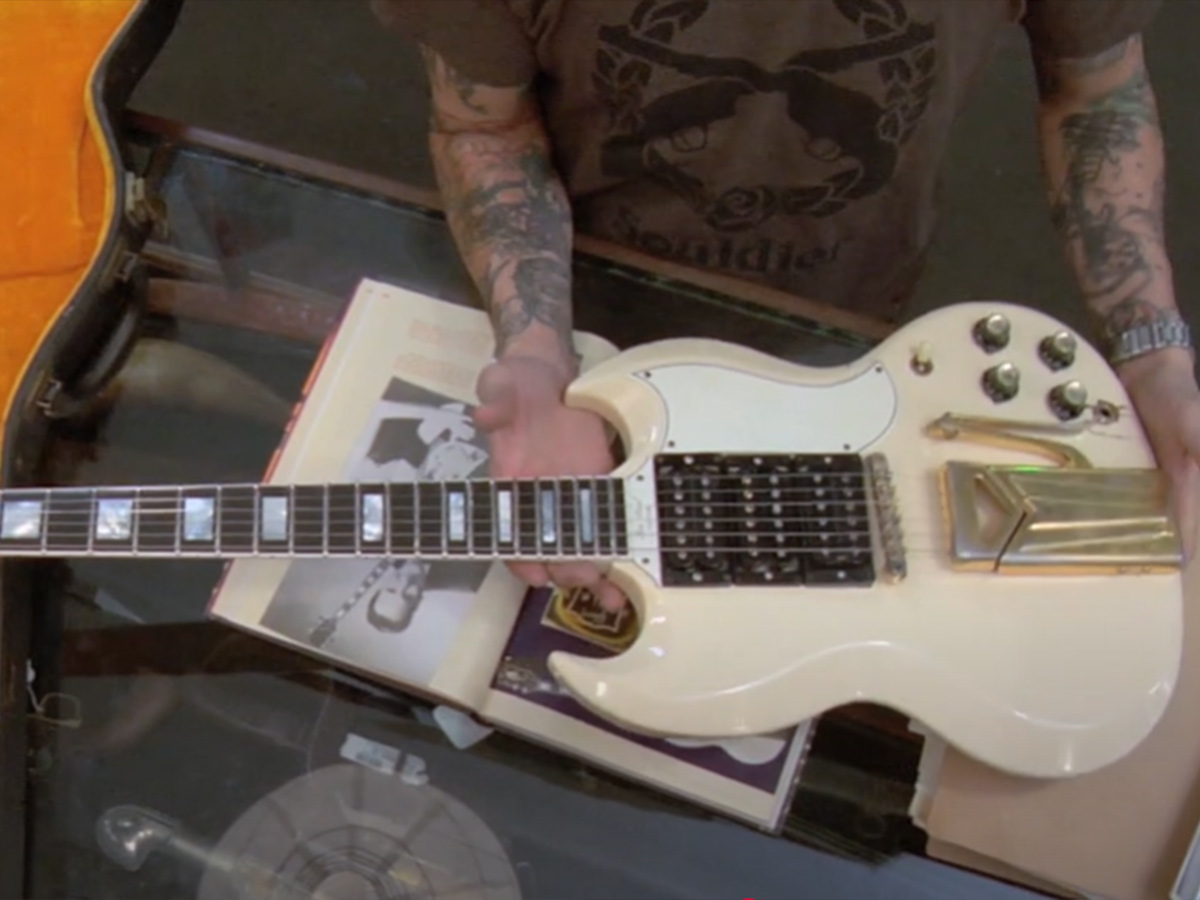
If you’re going to talk guitars, you can’t skip Mary Ford’s Gibson Les Paul. Known for her groundbreaking duets with Les Paul himself, Mary Ford helped shape the sound of modern music. Her personal guitar landed in the shop with a value of around $90,000, giving Rick a chance to own not just an instrument, but a piece of music history.
“These things are rare, but a Gibson Les Paul actually connected to Les Paul? The value could go through the roof,” Rick said. For fans of guitar lore, this was as much about honoring her role in music as it was about the dollar signs. It proved once again that Pawn Stars isn’t only about making money—it’s also about preserving cultural treasures.

Harry Houdini didn’t just escape from straitjackets—he escaped into legend. When one of his actual straitjackets made its way to the pawn shop, the estimated value hovered around $42,000. That’s a lot for something designed to tie you up, but considering its history, it was practically a bargain.
The straitjacket was more than just a prop—it was an artifact from one of the world’s greatest showmen. Houdini built his reputation on escapes that wowed audiences, and this jacket was a tangible piece of that magic. For Rick and the viewers, it was a rare glimpse at how performance, danger, and history can all be stitched together in one unforgettable item.

When football legend “Mean” Joe Greene’s Olympic medals turned up, they carried more than just precious metal value—they carried sports history. Appraised at around $30,000, the medals were a reminder that Greene wasn’t just a force on the gridiron, but also had ties to the Olympic stage.
Sports memorabilia can be hit or miss on Pawn Stars, but Greene’s medals were undeniably special. They connected two worlds—pro football and international competition—and gave fans a collectible that was as inspiring as it was valuable. For Rick, it was proof that sometimes the greatest treasures aren’t just about the price tag, but the stories they tell.

You know your pawn shop has range when an Egyptian mummy mask shows up on the counter. Valued at around $30,000, this artifact looked like it belonged in a museum—or at least in Indiana Jones’ carry-on luggage. It was one of those moments that made the show feel less like a pawn shop and more like an episode of Antiques Roadshow with higher stakes.
The mask’s allure wasn’t just its age, but the sense of mystery it carried. Who was the person behind it? What journey had it taken to end up in Las Vegas? For viewers, the mask was a reminder that history doesn’t just live in textbooks—it sometimes walks through a pawn shop door.

Every so often, an item clangs its way into the pawn shop that sounds like a direct call from history. That's what happened when a seller brought in a massive, verdigris-covered ship's bell from the 17th century. Purported to be from a Dutch East India Company vessel, this bell wasn't just old; it was a relic from the age of sail, when such bells were crucial for keeping time, signaling fog, and sounding alarms on the high seas.
After verifying its authenticity and doing a bit of haggling, Rick saw the maritime treasure as a solid investment and bought it for $15,000. While not the most expensive item to ever cross the counter, it's one of the oldest and most historically significant. For that price, he got a piece of history that survived centuries of storms, battles, and salty air—a deal that definitely has a nice ring to it.

If guitars could talk, this one would probably hum a Crosby, Stills & Nash tune. When a 1941 Gibson that once belonged to Steven Stills came into the shop, Rick didn’t strum around—he dropped $85,000 to snag it. That’s a hefty price, but considering the guitar was played by one of rock’s greats, it was like buying a front-row ticket to music history.
The Gibson carried the fingerprints of a legendary musician whose songs helped define an era. For a shop that’s seen its fair share of celebrity items, this guitar stood out because it wasn’t just memorabilia, it was playable art. And let’s face it—if you can say, “This was Steven Stills’ guitar,” you’re basically holding bragging rights with strings attached.