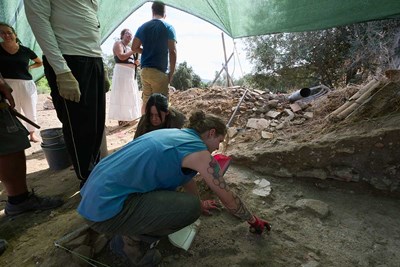
Imagine this. You’re in high school, sitting in your science class, and your teacher drops the ultimate "What did you do this weekend?" flex. “Oh, no big deal,” he says. “Just uncovered some 300-million-year-old footprints from creatures that walked the Earth before the dinosaurs.” That’s exactly what happened when Ashley Allen, a down-to-earth science teacher from Alabama, made the discovery of a lifetime.
Yes, you read that right. This unassuming teacher-turned-fossil hunter unearthed a treasure trove of prehistoric secrets in a coal mine. And it all began with a student’s offhand comment about his grandma’s property.
From Shark Teeth to Tetrapods
Ashley Allen didn’t start his career with a pickaxe in one hand and the secrets of the Paleozoic era in the other. No, he started like most of us—with a random fascination. Back in college, Ashley brought what he thought was a “meh” shark tooth to his orientation at the University of West Alabama. That tiny tooth led him to the university’s geologist, Richard Thurn, who immediately saw a spark in Allen and paired him up with graduate students to dig around in the dirt. That spark quickly turned into a flame. Fossil hunting became more than a hobby. t became an obsession.
Fast forward to 1999. Allen was teaching at Oneonta High School in Alabama when one of his students casually mentioned that his grandma owned an old coal mine in Union Chapel, Walker County. Thinking it was probably just another one of those “my-dad’s-uncle’s-friend-saw-Bigfoot” kind of claims, Allen didn’t take it too seriously until the student insisted. The teacher decided to investigate the site, and good thing he did. What he found there would change paleontological history.
The Scoop on the Slab
Allen’s first big “aha” moment at Union Chapel happened when he found what looked like a series of footprints frozen in ancient mud. These weren’t just any footprints. They were from tetrapods, early four-legged creatures that roamed the Earth some 300 million years ago. Imagine salamanders but with a much cooler backstory.
“I found a slab with calamites, these cool extinct plants, alongside three super distinct trackways,” Allen recalls. “It didn’t take a genius to figure out this was something extraordinary.” Spoiler alert: He’s being humble. It did take a genius.
Word of his discovery spread quickly. Allen presented his findings at a meeting of the Alabama Paleontological Society, and suddenly, the whole paleontology world was abuzz.
From Mud Pit to Global Fame
Enter Steve Minkin, a renowned paleontologist who got wind of Allen’s discovery. He realized the Union Chapel site wasn’t just a “pretty cool” fossil find; it was one of the most important fossil sites of its kind. The site became famous for preserving trace fossils (think footprints, not bones), leading to a massive effort to systematically catalog everything.
Volunteers and researchers flocked to Union Chapel, even braving miserable weather to document the fossils. They eventually created a database so detailed that it made Union Chapel the go-to spot for learning about life in the Carboniferous period.
The site gained international recognition when German scientist Hartmut Haubold declared it “the single most important site from this era.” Considering that this came from the expert on pre-dinosaur life, that’s like being handed an Oscar in the geology world.
Saving the Slice of Earth’s History
Of course, digging up 300-million-year-old secrets doesn’t come without its challenges. For years, Allen and his coalition of fossil enthusiasts worked tirelessly to preserve the site. Their efforts paid off in 2000 when Congress passed a law protecting Union Chapel as a scientific and educational resource. Today, it’s under the care of the Alabama Department of Conservation and Natural Resources and is only accessible for supervised visits.
And yes, you can still take home fossils (score!), but only if they’re not rare or scientifically significant. If you manage to stumble across a groundbreaking discovery, though, prepare to part ways. Those go straight to places like the McWane Science Center or even the Smithsonian. Fair trade, right?
The Real Gold in the Coal Mine
Ashley Allen could’ve stuck to the classroom and left fossil hunting as a weekend hobby, but he didn’t. Not just because it’s thrilling to uncover ancient ecosystems under piles of coal dust, but because he wanted to ignite the same passion for science in his students. Allen continues to lead fossil hunts, sharing his knowledge with everyone from elementary school kids to Ph.D. researchers.
Reflecting on his wild, decades-long exploration of Alabama’s ancient past, Allen shares, “It’s funny. It all started with a random shark tooth in the Chipola River. Now we’re here, peeling back history to see what life looked like before the dinosaurs. Who would’ve thought?”
And don't forget, it was a seemingly offhand tip from a student about his grandma’s coal mine that led to this discovery. If that’s not a call to listen to your students (and maybe dig into their local legends), we don’t know what is.