
Few crimes have the swagger and audacity of the Lufthansa Heist. On December 11, 1978, a group of thieves struck at JFK Airport, making off with $5 million in cash and $875,000 in jewelry. That’s roughly $27 million today, in case you’re wondering if your garage sale earnings could compete. The robbery shocked law enforcement and the public alike, not just for the money taken, but for how meticulously it was executed. The heist became legendary in criminal lore and later inspired the movie Goodfellas, cementing its place in pop culture.
The aftermath was grim and chaotic. Many involved met untimely deaths under mysterious circumstances, as the mob tried to tie up loose ends. Despite investigations, much of the stolen cash and jewels vanished without a trace.

In 1982, a simple headache turned deadly for several people in the Chicago area. The culprit wasn't a new, terrifying illness but something far more sinister hiding in plain sight: cyanide-laced Tylenol capsules. Panic spread quickly as authorities realized someone was tampering with the popular pain reliever, turning medicine cabinets into potential crime scenes. Johnson & Johnson, the maker of Tylenol, responded by pulling 31 million bottles off the shelves nationwide.
The case triggered a massive investigation, but the killer was never found. The true legacy of this tragedy, however, can be seen every time you open a bottle of over-the-counter medication. The Tylenol Murders single-handedly changed the pharmaceutical industry, leading to the creation of tamper-resistant packaging like foil seals and plastic rings.

In 1692, the small town of Salem, Massachusetts, became the epicenter of a full-blown panic that had little to do with actual witchcraft and everything to do with fear. It all started when a few young girls began exhibiting strange behaviors, and soon, accusations of bewitchment were flying faster than broomsticks on Halloween. What followed was a textbook case of mass hysteria, where spectral evidence—testimony that a victim’s spirit appeared to them in a dream or vision—was considered legitimate proof. This flimsy basis for conviction led to a storm of accusations, public shamings, and packed jails.
The trials snowballed into a legal and social disaster. Over 200 people were accused, and twenty were executed, mostly by hanging. The proceedings were a chaotic mess of personal grudges, social anxieties, and religious extremism masquerading as justice. Eventually, public opinion turned, officials admitted the error of their ways, and the colony formally apologized for the events.

The Roaring Twenties weren't just about jazz and flappers; they also gave us one of the biggest government corruption cases in American history. The scandal got its unusual name from Teapot Dome, a petroleum reserve in Wyoming that was supposed to be set aside for the U.S. Navy. Instead, Secretary of the Interior Albert Fall decided these valuable oil fields would be better off in the hands of his private-sector pals. He secretly leased the reserves to oil magnates in exchange for some very generous "gifts," including cash, bonds, and even prize-winning cattle.
It took a while for the details to surface, but when they did, the public was outraged. The scandal exposed a level of greed and corruption that reached the highest levels of President Warren G. Harding's administration. The ensuing investigation dragged on for years, cementing the scandal in the public consciousness as a prime example of government officials lining their own pockets. Fall became the first U.S. cabinet member to go to prison.

Some criminals want money, others want power, and then there are those who just want to watch the world squirm. The Zodiac Killer falls squarely into that last category. This murderer terrorized Northern California in the late 1960s and early 1970s, attacking young couples in secluded areas. But the crimes themselves were only part of his chilling performance. The killer's true signature was his communication with the press and police, sending a series of taunting letters and bizarre, cryptic ciphers that promised to reveal his identity.
Despite a massive investigation and countless theories, the Zodiac Killer was never caught. His identity remains one of the greatest unsolved mysteries in American criminal history. The ciphers, filled with strange symbols, have captivated amateur and professional cryptographers for decades, with only a few ever being cracked. The killer claimed numerous victims, but his true legacy is the lingering fear and endless speculation he created. He simply vanished, leaving behind a trail of coded messages and a case file that remains stubbornly open to this day.

The story of Bre-X Minerals is a classic get-rich-quick tale that went spectacularly wrong. In the mid-1990s, this small Canadian company announced it had discovered a massive gold deposit deep in the jungles of Borneo, Indonesia. The find was hailed as one of the largest in history, and investors couldn't throw their money at the company fast enough. Bre-X's stock price soared, transforming a penny stock into a multi-billion-dollar giant almost overnight. It seemed too good to be true, and as everyone would soon find out, it absolutely was.
The whole thing came crashing down when an independent firm was brought in to verify the claims and found… nothing. It turned out the company’s geologist had been "salting" the core samples with gold from his own wedding ring and other sources. The fraud was exposed, the stock became worthless in an instant, and billions of dollars in investments vanished into thin air. The geologist mysteriously fell from a helicopter shortly before the scandal broke, leaving a trail of chaos and financial ruin.

On the day before Thanksgiving in 1971, a man in a business suit, who identified himself as Dan Cooper, boarded a flight from Portland to Seattle. He calmly informed a flight attendant that he had a bomb in his briefcase and handed over a note with his demands: $200,000 in cash and four parachutes. After the plane landed in Seattle, his demands were met, the passengers were released, and the flight took off again, supposedly heading for Mexico City. Somewhere over the dense forests of southwestern Washington, Cooper did the unthinkable—he parachuted out of the back of the plane with the money and into legend.
The ensuing manhunt was one of the most extensive in U.S. history, but it turned up nothing. No Cooper, no parachute, and for years, no money. The only tantalizing clue appeared in 1980 when a young boy found a small bundle of decaying $20 bills from the ransom money on a riverbank. To this day, the identity of D.B. Cooper (a name mistakenly created by the media) and his ultimate fate remain a complete mystery. Did he survive the jump and live out his days in quiet anonymity, or did he perish in the wilderness?

On Christmas Eve 2002, a pregnant Laci Peterson was reported missing from her home in Modesto, California. Her husband, Scott Peterson, claimed he had gone fishing that day and returned to an empty house. The story immediately gripped the nation, with Laci’s smiling face plastered across news channels. As the search intensified, public sympathy for the seemingly grieving husband began to sour. Details emerged about Scott's affair and a recent life insurance policy he had taken out on his wife, painting a picture that was far from that of a distraught husband.
The case transformed from a missing person search into a grim murder investigation when the remains of Laci and her unborn son washed ashore in San Francisco Bay, not far from where Scott said he was fishing. The circumstantial evidence was damning, from his suspicious behavior to the lies he told police and his mistress. The trial became a media circus, captivating viewers who followed every twist and turn. Scott Peterson was ultimately convicted of the murders, turning a story that began as a holiday tragedy into one of the most debated true crime cases of the early 21st century.

In 2003, a team of thieves decided to rob a place that was supposedly impenetrable: the Antwerp Diamond Center. This wasn't a smash-and-grab job; it was a meticulously planned operation years in the making. The crew, led by Leonardo Notarbartolo, rented an office in the building, allowing them to study the security systems up close. They painstakingly bypassed a fortress of safeguards, including a lock with 100 million possible combinations, infrared heat detectors, a seismic sensor, and a magnetic field. It was a heist so elaborate it sounds like something from a movie.
The morning after the robbery, the vault was discovered wide open, with 123 of the 160 safe deposit boxes emptied. The thieves made off with at least $100 million worth of diamonds, gold, and other jewels, earning it the nickname "the heist of the century." Although Notarbartolo and some of his crew were eventually caught, the bulk of the loot was never recovered.

It all started with what was dismissed as a "third-rate burglary." In June 1972, five men were caught breaking into the Democratic National Committee headquarters at the Watergate office complex in Washington, D.C. They were attempting to bug the offices and steal sensitive documents. At first, the Nixon administration tried to distance itself from the incident, but two young reporters from The Washington Post, Bob Woodward and Carl Bernstein, smelled a story. With help from a mysterious high-level source known only as "Deep Throat," they began to connect the dots.
Their investigation slowly unraveled a vast conspiracy that reached the highest levels of government. It became clear that the break-in was just one part of a larger campaign of political espionage and sabotage, all orchestrated to help re-elect President Richard Nixon. The subsequent cover-up involved hush money, destroyed evidence, and a president who insisted, "I am not a crook." As the truth came out through congressional hearings and the release of secretly recorded White House tapes, Nixon’s presidency crumbled. Facing certain impeachment, he became the first and only U.S. president to resign from office.

In 2017, the crime of the digital age hit a new low. Equifax, one of the three major credit reporting agencies entrusted with our most sensitive financial data, announced it had been hacked. This wasn’t just a small-scale attack; it was a catastrophic failure of security that exposed the personal information of 147 million people. Social Security numbers, birth dates, addresses, and driver's license numbers were all scooped up by cybercriminals. The cause? The company had failed to patch a known software vulnerability, essentially leaving the digital door wide open for months.
The fallout from the breach was massive and messy. Suddenly, nearly half the U.S. population had to worry about identity theft on a grand scale. Equifax’s response did little to soothe public anger, as they offered a clumsy and confusing credit monitoring service after the fact. The incident served as a jarring wake-up call about the fragility of personal data online.

What happens when you put good people in a bad place? In 1971, Stanford psychologist Philip Zimbardo decided to find out. He created a mock prison in the basement of the university’s psychology building and recruited male college students to play the roles of prisoners and guards. The study was supposed to last two weeks to examine the psychological effects of perceived power. The participants were given uniforms and instructions, with the guards told to maintain order without using physical violence. It sounds like a simple academic exercise, but it quickly became anything but.
Within just a couple of days, the experiment spun wildly out of control. The "guards," swept up in their roles, became increasingly authoritarian and, in some cases, sadistic. They subjected the "prisoners" to psychological torment, humiliation, and cruel punishments. The prisoners, in turn, became passive, helpless, and showed signs of extreme emotional distress. The situation became so toxic and ethically compromised that the experiment had to be shut down after only six days.

In 2019, the world learned that some wealthy parents had found a "side door" into elite universities for their children, and it wasn't through stellar grades or impressive extracurriculars. Instead, they hired a charismatic college consultant named Rick Singer, who orchestrated a massive bribery scheme. For hefty sums, Singer arranged for students to be admitted as fake athletic recruits, complete with Photoshopped images of them playing sports they'd never even tried. He also facilitated cheating on college entrance exams, all to guarantee spots at top schools like Yale, Stanford, and USC.
The scandal exploded into the headlines, especially with the involvement of high-profile parents like actresses Felicity Huffman and Lori Loughlin. The public was both fascinated and furious, watching as a story of privilege and entitlement unfolded in federal court. The case exposed a corrupt system where wealth could buy academic credentials, sparking a national conversation about fairness and integrity in college admissions. In the end, dozens of parents, coaches, and administrators faced criminal charges, proving that even the rich and famous aren't always immune to the consequences of their actions.

In July 1997, the glamorous world of high fashion was violently interrupted on the steps of a Miami Beach mansion. Gianni Versace, the celebrated designer whose name was synonymous with bold style and luxury, was returning home from his morning walk when he was shot and killed. The brazen daylight murder of such a public figure sent immediate shockwaves around the globe. The crime scene, on the steps of his lavish Ocean Drive residence, became an instant spectacle, as the world tried to make sense of a senseless act of violence.
The killer was quickly identified as Andrew Cunanan, a spree killer who had already murdered four other men in a cross-country rampage. Versace was his final, and most famous, victim. The motive for the murder remains a subject of debate, as Cunanan took his own life on a houseboat just eight days later, leaving a trail of questions behind him. The death of Versace was a tragic end to a brilliant career.

Long before email scams promised you a Nigerian prince's fortune, there was Charles Ponzi and his too-good-to-be-true investment plan. In 1920, Ponzi convinced thousands of people he had discovered a foolproof way to make money using international postal coupons. He promised investors an astonishing 50% return in just 45 days, a rate that should have set off alarm bells everywhere. But in the booming economy of the Roaring Twenties, people were eager to believe, and money poured in faster than Ponzi could count it. At his peak, he was raking in millions.
There was just one tiny problem: the business was a complete fabrication. Ponzi wasn't actually investing the money; he was just using cash from new investors to pay off the earlier ones. This created the illusion of a profitable enterprise while he siphoned off a fortune for himself. Of course, the house of cards eventually collapsed when he couldn't attract enough new money to maintain the payouts. The scheme fell apart, wiping out the savings of countless victims. His name became so synonymous with this type of fraud that we still call it a "Ponzi scheme" today.

The killing of John F. Kennedy is something most people know about, but it’s still one of the most infamous crimes ever. In 1963, Kennedy was visiting Texas when a sniper murdered him.
Most believe Lee Harvey Oswald was the one that fired from a sixth-floor window of the Texas School Book Depository, but some people still have their doubts. Oswald was arrested but was promptly killed by Jack Ruby, a nightclub owner.

Patty Hearst was the granddaughter of William Randolph Hearst, the man who was the inspiration for Citizen Kane. In 1974, she was kidnapped from her Berkeley apartment by the Symbionese Liberation Army. These left-wing revolutionaries were later spotted robbing a bank in San Francisco, and something surprising was discovered...
Patty Hearst wielding a machine gun! A couple of weeks following this, a video released where she declared her allegiance with the group, claiming her new name was “Tania.” She was eventually captured and sentenced to 35 years in prison, but was ultimately pardoned in 2001.

Barings Bank was the oldest investment bank in Britain and had high profile clients – one including the Queen! Unfortunately, it didn’t last. Nick Leeson was a derivative broker who caused the bank to fail. He manipulated the internal system and created a secret Barings account where the bank automatically covered its losses.
He started risking vast amounts of money betting in the Japanese stock market. After a giant earthquake in 1995, Leeson had over $1 billion in losses, and the bank couldn’t cover it. The bank collapsed that year and was purchased by the Dutch financial company ING for one British pound.

In July 1975, the notorious Jimmy Hoffa (left in the photo) disappeared from the Machus Red Fox Restaurant in Detroit, Michigan. In the early years of his Teamsters work, he became involved with organized crime, and he was supposed to meet two Mafia members that night.
The two members denied meeting him, and police attempted to investigate Hoffa’s disappearance. Unfortunately, they were unable to solve it. The head of the FBI’s Detroit office claims to know who did it, but no arrests were made. He was declared legally dead in 1982.

In 1892, they didn’t have forensics, so it was difficult to know who did what unless there were witnesses. Well, no one saw what happened to the Borden family. One morning in August, the bodies of Abby and Andrew Borden were found dead in their home. A hatchet was determined to be the weapon used.
Authorities looked toward Andrew’s daughter Lizzie as the prime subject as she was the one who found the bodies soon after the attack. The newspapers ran with this and came up with the famous “Lizzie Borden took an ax..." tune. Lizzie was acquitted in the murders but ostracized by the community.
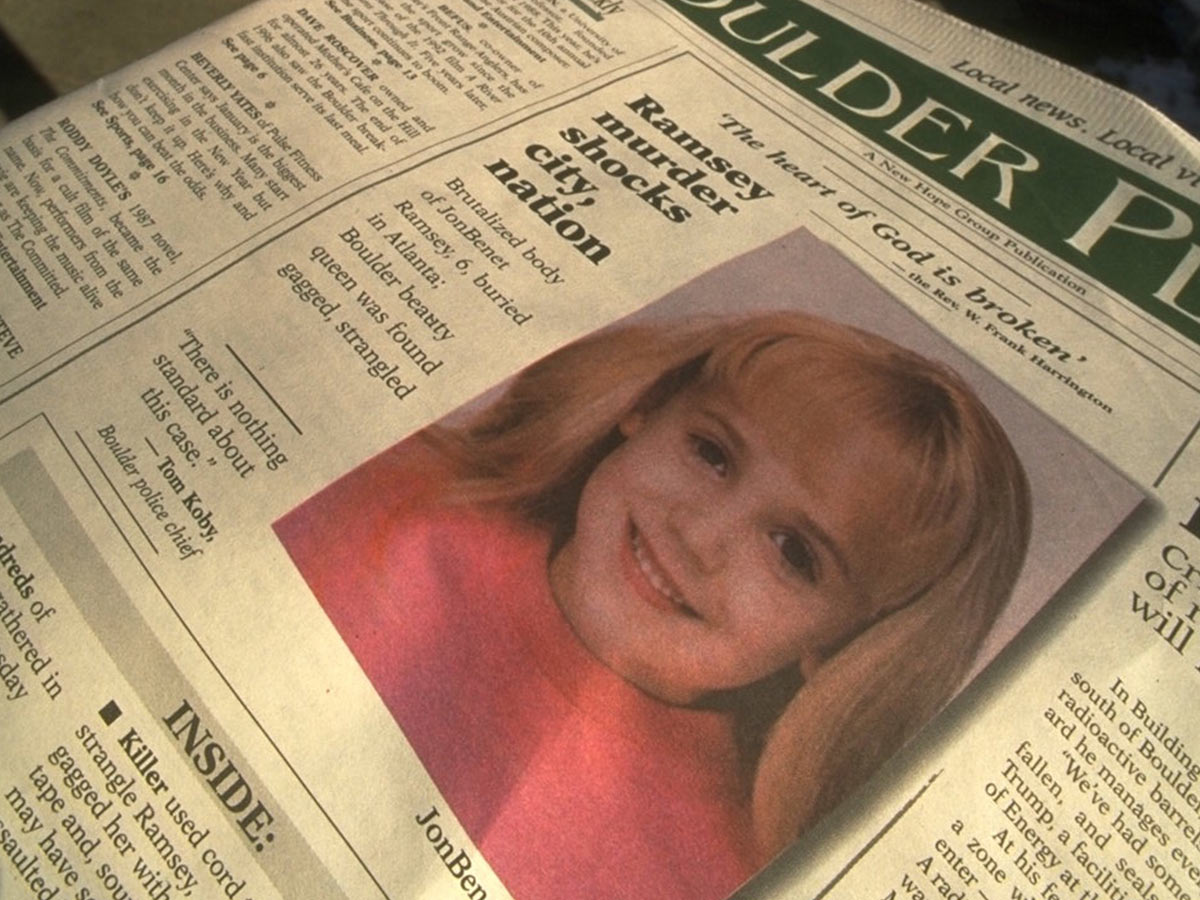
The JonBenet Ramsey case was hard for the whole nation. A little six-year-old girl disappeared from her home in Boulder, Colorado, the day after Christmas. A lengthy ransom note was discovered, and the girl’s body was found in the cellar eight hours later.
Authorities became suspicious and began to look into the parents, trying to find out if they had been involved. No one was convicted, but police believed that JonBenet’s brother was likely the cause of her death.

This terrifying crime may make you think twice before camping. In 1981, Glenna Sharp was staying in a cabin with her five children in the Sierra Nevada mountains of Keddie, California. Sometime in the middle of the night, someone entered the cabin and used a claw hammer on Glenna, her 15-year-old son, and his 17-year-old friend.
Later that morning, the eldest daughter discovered their bodies and realized her sister Tina had disappeared. Somehow, the youngest brother and his friend slept through the attack. No arrests were made, but Tina’s skull was later discovered near Feather Falls.

The Mona Lisa is one of the most famous paintings ever made, but its location wasn’t always known. In 1911, someone took the portrait of the curious woman from the Louvre. The theft shook France. Borders were immediately closed, administrators were dismissed, and the search was on.
Months later, the Uffizi Gallery in Florence captured a criminal by the name of Vincenzo Perugia. He’d brought the Mona Lisa to a local antique dealer to sell it and restore it to Italy, where he felt it belonged. He was found guilty but only spent a few months in jail.

A train robbery might be something out of the 1800s, but this one surprisingly occurred in 1963. A total of 120 bags packed with $7 million had been taken by 15 thieves who held up the Royal Mail train between Glasgow and London. The operation took just 15 minutes but wasn’t as smooth as an Ocean's movie.
The driver who was hit in the head never fully recovered, and the thieves left fingerprints everywhere. Most were arrested, but Ronnie Biggs escaped and eluded police for years. It wasn’t until 2001 that he went to jail after turning himself in. The man in the photo is none other than Bruce Richard Reynolds, the mastermind behind the heist.

The Brinks Job is something you’d see in a heist movie. A gang of 11 men robbed the Brinks headquarters in Boston after an 18-month quest. The plan went off with miraculous precision. The men stole more than $1.2 million in cash and $1.5 million in checks and securities. At the time, it was the biggest heist in American history, leaving the country dumbfounded.
Unfortunately, the gang had a falling out, and this led to their capture. One of the members tried to hire a mobster to kill another member, Joseph O’Keefe. Following this attempt, O’Keefe talked with the FBI. Afterward, all of them were sentenced to life in prison. O’Keefe was spared, getting only four years.

The Villisca Axe Murders is one of the strangest mysteries of all time. It took place in 1912 in a rural home in Villisca, Iowa. One evening, the family of six welcomed two of their children’s friends to stay the night, but it soon turned into a deadly sleepover.
Someone entered the home and murdered everyone inside! A neighbor discovered the crime, but no one knew who had done such a thing. No one was convicted, and the case remains open to this day.

H. H. Holmes, or Herman Webster Mudgett, is often considered one of the most horrific serial killer in the United States, and some even think he was Jack the Ripper. While this is debatable, he is one of America’s first serial killers. What did he do?
Well, Holmes confessed to 27 murders, but police only found 9 bodies. While he did some horrible stuff prior, his worst offenses took place in Chicago. This was where he built his “Murder Castle.” Holmes didn’t keep a construction crew long, and the place was peculiar. There were stairways that ended nowhere, winding passages, and more. Only Holmes knew how it worked, and it was where he hid the bodies of his victims.

The Lindbergh Baby was once the “Crime of the Century.” In 1932, aviation hero Charles Lindbergh claimed that his son was snatched from his crib in the middle of the night and a ransom note was left behind that demanded $50,000.
Every resource was used to try and find the baby, but the police couldn’t find anything. Despite this, the police arrested Bruno Richard Hauptmann for the crime. He was tried, convicted, and executed in 1996, insisting he was innocent the whole time.

The Black Dahlia is a case that still haunts Los Angeles today. Elizabeth Short was an upcoming actress when her body was found in Leimert Park in 1957. It was drained of blood and halved at the waist. Furthermore, her mouth had been cut into an exaggerated oversized smile.
Her death was sensationalized, but the investigation was never completed. Over 200 suspects were considered, but it remains a mystery today.

This case is something that nearly everyone knows, but it’s still incredibly infamous. In 1994, Simpson’s ex-wife Nicole Brown Simpson and her friend Ron Goldman were found dead in Nicole’s condo in Los Angeles.
O.J. instantly became a person of interest, and he actually led the police on a low-speed car chase. The former NFL player was eventually caught and tried for the murders. It was claimed that he killed them out of jealousy. In the end, he was acquitted on both counts.


#/media/File:Sears_Crossing.JPG)