
Everyone knows about the Mona Lisa. Leonardo da Vinci worked on the painting around 1503-06 until 1517. The famous painting is permanently housed at the Louvre in France and has approximately 6 million visitors per year. It has an appraised value of nearly $800 million and holds the highest insurance value of any painting in history.

Housed at the British Museum, this granodiorite stone slab is inscribed with a decree issued in Memphis, Egypt, in 196 B.C. The decree appears in 3 scripts: Demotic Egyptian, Greek, and Egyptian hieroglyphs. Its discovery allowed hieroglyphs to be deciphered for the first time.

Being the oldest known biblical manuscripts, these scrolls represent the greatest archaeological find of the 20th century. Some are located at the Rockefeller Museum in East Jerusalem while others can be found at the Israel Museum in West Jerusalem.

King Tut's casket alone is worth about $13 million. His mummy and the relics from his tomb give an incredible glimpse into the trappings of ancient Egyptian culture. While normally housed in the Egyptian Museum in Cairo, many of these treasures have been exhibited internationally.
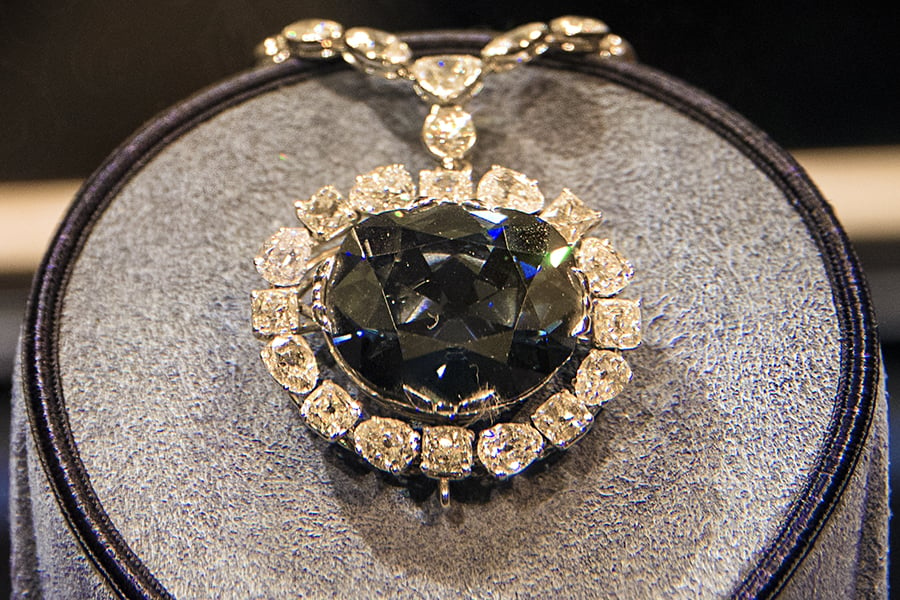
The 45.52-carat deep blue Hope Diamond is estimated to be worth between $250 - $350 million. It was ever so casually mailed to the Smithsonian in a plain brown wrapper via registered mail by donor Harry Winston. It's one of the most visited museum objects in the world.

This sculpted marble depiction of the Great Panathenaia was originally created to adorn the upper part of the Parthenon's inner chamber. Originally 525 feet long, it featured 378 figures & deities and over 200 animals. The Acropolis Museum housed 164 feet while another 262 feet can be found at the British museum.

Now housed at the Louvre, this relief featuring King Ashurnasirpal II is from the palace of Nimrud in Assyria where it covered part of an unbaked brick wall. This type of architecture was adopted in Assyria in the 9th century B.C.

Residing in the British Museum, this 4,000-year-old clay tablet relays in cuneiform the 1750 B.C. copper merchant Nanni's dissatisfaction with the quality assurance and service of El-nasir. It's the oldest customer service complaint discovered to date.

The Aztec Sun Stone is a 24-ton sculpture honoring the sun god Tonatiuh that was carved in the 15th century and is now housed at Mexico's National Museum of Anthropology. It's sometimes called the Aztec calendar and has been reproduced on many products in the modern era.

An oil painting on canvas valued at more than $100 million, The Starry Night by Vincent van Gogh is in the permanent collection of the Museum of Modern Art in New York City. It's regarded as one of Van Gogh's finest works and is one of the most recognized paintings in the history of Western culture.

These treasures aren't actually gold, but the 259 objects excavated from Troy during 1872-1890 are a goldmine of culturally significant vessels, anthropomorphic figures, jewelry, and rock crystal artifacts. You can find them at the Pushkin State Museum of Fine Arts in Moscow.

The first $20 coin was minted in 1849. It's the rarest US coin and is valued at around $20 million. The only known remaining example now resides in the National Numismatic Collections at the Smithsonian.
